
In this video you will learn a basic pruning expectations for shrubs (large and small) commonly seen in a HOA community.
Can’t watch the video? Check out the transcript, below.
Hello everyone. My name is Jason Smith. I’m with Bland Landscaping. Today we’re going to talk through different types of shrubs, their growth patterns, aggressive growers to medium to slow growers, and how we prune them through the year. We’re also going to talk about ornamental grasses and some winter pruning on trees as we go through the day.
So, just some examples of aggressive grows would be wax worn. We probably have to prune them two, sometimes three times a year. And if it’s somewhere where sight line visibility is an issue, say at a stop sign, we’re probably pruning it more. When they get big like this, it could be a good idea to do rejuvenation pruning if it’s blocking off something that you want to see in the back. We could come through say March one year and cut it down to here. It’ll flush back out that season and then you could keep it at a more reasonable height if you weren’t trying to screen something out. But these are aggressive growers.
We’ve also got a Nelly Stevens here, which is borderline aggressive to medium. They do get very large. We often see them planted in the wrong spot. Typically, in HOAs, we see them four or five feet off the corner of a house, which it’s going to encroach on the house. So, there we consider an aggressive grower because we’re having to prune it at multiple times of the year really to keep it in shape and keep it off the house.
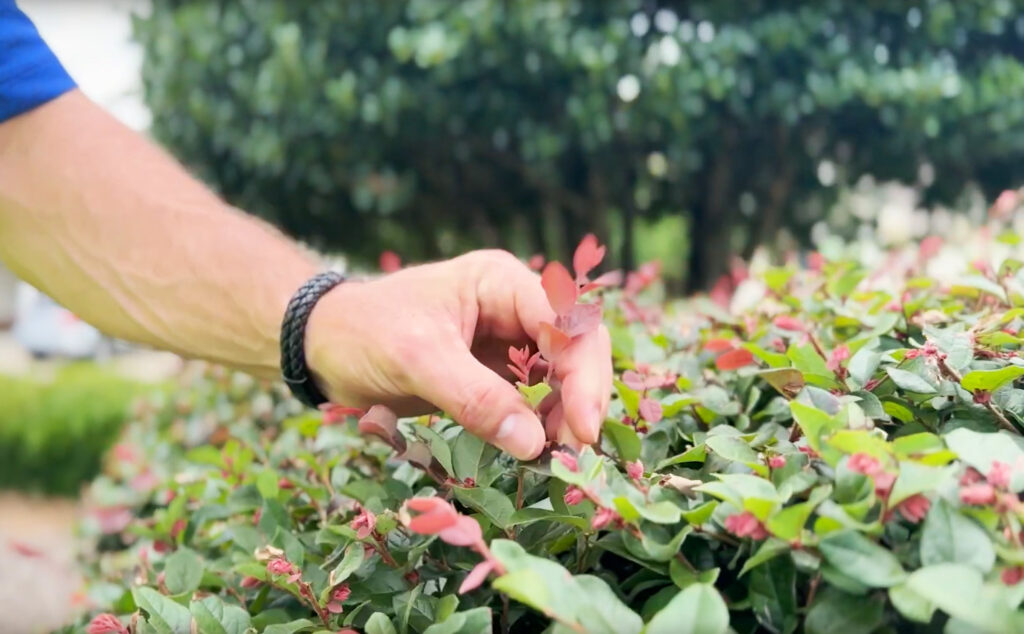
Here we have a good example of a Laura pedalum that we’ll see in larger HOAs or even planted in common areas or around homes. So, we would consider this an aggressive grower. We’ll prune them two to three times a year depending on location, how much it’s in the sun, where it is. This one’s been recently pruned. We do have to shape them in some manner. We like to see them a little bit fluffier with a little bit of new growth on them. You get this almost purple burgundy-ish type color to it when it gets slightly fuzzy and doesn’t look as as tight. That covers up some of this green leaf which gives it a more natural, flowy look with that great color of the new leaves on it. This is one freshly pruned.
Next to me, we have a emerald arbor vidi. They’re great plants. They are very slow growing. They will get a decent size. We typically see them planted around buildings and tucked into the corners or on a corner which is great and they look great there. The problem that we run into sometimes is the proximity to the building or structure. As you can see, this one’s starting to get up into the gutter and near the building. And unfortunately, there’s no good pruning solution for that. So, we do like these. Great for screening. Sometimes just keep them a little away from the building.
Now, we have a plant called Distillium. There’s many different varieties. Typically we consider them a slow to medium grower. We would like to hand prune them a little bit more. When we inherited this hedge, it had been sheared in this fashion over the last few years. So, it’s made them somewhat of an aggressive grower as you can see. And we’re having to come in and continue the shearing process. The only way to really reset that here would be to do some type of rejuvenation pruning and try and reset them and get the sides back down and make it a little bit more manageable for hand pruning to keep a little bit more of a natural flowing look than the hedge that we have here.
Next, we have a great example of a single stem crepe myrtle. So you’ll see crepe myrtles in single stem and multi- trunk form. Both are a great plant, great for shade, great for color in the summer. This one’s been taken care of well. It hasn’t been topped or anything like that. Typically when we’re pruning these, it’s in the winter for crossing branches or anything that may be rubbing together or to thin out the canopy a little bit if they’re a little shorter. Here, the only pruning we’re doing through the season is for really what we consider pedestrian clearance. So maybe pruning up seven to eight feet just so we can get under things, make it easy to walk under if there’s a sidewalk or easy to mow the turf around it. So those are the things that we do to them. But again, we are not topping and cutting off chunks of the top of the tree.
So here we have a typical example of a boxwood in a hedge form. Many different varieties of boxwood. We see them all over the place. Typically, they are planted as a more formal hedge and can be pruned in a more formal hedge. We prune them maybe once to twice a year, so they’re in that low to mid-range on growth aggressiveness. We’ll typically prune late spring, maybe early fall, late summer. One thing we have noticed with them is if you prune them and you’re in the 90s in the middle of the summer, we can see some damage, just some burnt leaves and things like that along the pruning line. So, we try to avoid pruning them in the middle of the summer when it’s very hot. Um, but they do look good as a traditional hedge.
All right. So, next to me here, we have a Carissa holly. This is what we consider low on the growth pattern for the year. We typically prune them maybe once a year. Here you can also see where it’s reverting back to the parent plant. As you can see the leaves are much more spiky, a little more aggressive looking than what we’re looking for in the carissa. Sometimes you can cut this reversion out and it’ll flush back out. But typically when they revert, they’ll somewhat stay in that stance.
Here we’ve got a couple examples of ornamentals. We have mu grasses and we have hydrangeas. So in larger HOAs we’re seeing more and more of these get planted. The hydrangeas specifically we may prune them depending on the variety in the common areas but typically around someone’s home or someone’s villa we would not prune them due to the sensitivity on timing and variety and for a variety of other factors. We would not prune those. If somebody requested it at a certain time frame, we could possibly do that. But in general, we do steer clear of pruning them around somebody’s residence.
Now, muhly grasses. If we prune, we do that in the off season, likely in February. We’ve found over the last few years that pruning them does not often go well. Even if we’re just lightly pruning them, we have found that they’re having trouble flushing back the next year. So, we’re backing off of that for the most part. We’ve also found that heavy mulch buildup around the base also seems to make them fussy in the spring with leafing out. So, we also suggest not piling mulch up around them, which in general you shouldn’t do around plants at the base.
So, these are a few examples of ornamentals and how we may treat them in your community.