
When it comes to managing Commercial, HOA, and or Multi-Family properties, communication between your landscape and lake & pond service providers isn’t just helpful—it’s essential.
In this episode of “Smarter in 5 Minutes,” we highlight the benefits of integrated service delivery and why the partnership between Bland Landscaping and Foster Lake & Pond Management is changing the game for clients across the Southeast US. Watch the video, or read the transcript, below. And subscribe to Bland Landscaping Company on YouTube for more!
Video Transcript
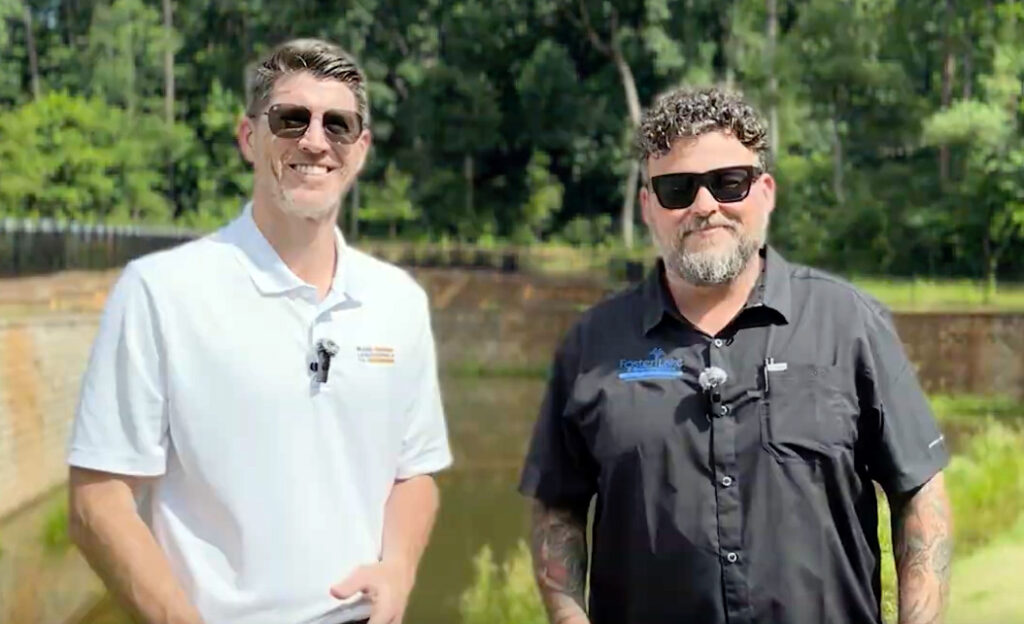
Hi, I’m Mitchell Morton with Foster Lake and Pond Management. And I’m Tyner Tew with Bland Landscaping. We’re going to make you smarter in five minutes!
When managing storm water devices, it’s always important to have a relationship with a landscaper on site. At Foster Lake and Pond, we have an advantage because we’re part of the Bland Landscaping team. That makes communication internally and with the client a lot easier.
So, one of the big advantages that we had was the foresight of when to bring Foster Lake into the Bland Landscaping fold. We realized that the two worlds really should be one, because a lot of the issues that we find when we are on a property for landscaping are about stormwater management. Foster Lake needs to be part of our relationship to landscaping for the benefit of the customer and our teams.
Mowing boundaries are probably the number one issue we run into in stormwater management. Many landscapers don’t realize that the entire footprint of the stormwater device needs to be mowed to a compliance level. At Foster Lake, that’s something we specialize in. We have special equipment like Ventrax that can handle severe slopes like we see on the backs of dams. These types of mowings are compliance mowings, but not always finish mowings. So, there needs to be communication with the landscape contractor to make sure that the objective is clear and that everyone has a map and knows where their boundaries start and stop.
One of the advantages that the Bland Landscaping teams bring is that, with our service crews being on sites weekly during the growing season and weekly during the the dormant months, we have many eyes and ears on site for internal communication and evaluation. We’re able to identify potential non-compliant issues earlier, like erosion on banks or aggressive algae blooms. We’re on the lookout for those issues now where we may not have done so in the past given that we had that we had separate silos we were responsible for. Now that we’re a unified group, even in the RFP process of a community that we may be putting a a proposal together for, we’re able to have those brainstormin sessions internally as we’re working through a proposal process with Mitchell and his team. That allows us to be able to recommend the right application and the right repair for the problem that the customer is experiencing or they may not even be aware of yet.
Another key component for your stormwater and landscaping professionals to work together is communication regarding treatments of the turf and water. Certain products should not be used if the water if it’s being used for irrigation purposes. Knowing that ahead of time can save a lot of time and money for our customers. From a turf side, there should be a 50 to 100T buffer for most turf applications for insects, even fertilizer. We want to minimize the potential for inappropriate products to make their way into our water. There are natural organisms that live in there and by maintaining buffers and communication between your landscaper and your storm water professional, you can ensure that all teams will handle things the right way.
So, a couple of points to take home with you:
- Have a map for all teams. Make sure you know where stormwater management ends and landscaping begins. Having those those areas clearly defined and communicated between your landscape provider and your stormwater management provider will eliminate bad outcomes.
- Anytime you’re working around water, make sure your landscaper knows that we want to keep at least a 50 to 100 foot buffer around the pond when applying fertilizers and herbicides.
- Encourage your stormwater professional and your landscape contractor to work together to make sure that the customer is satisfied.
Ready to work with us? Contact the team at Bland Landscaping or Foster Lake today.
Looking for career opportunities? Learn more about working with us.