
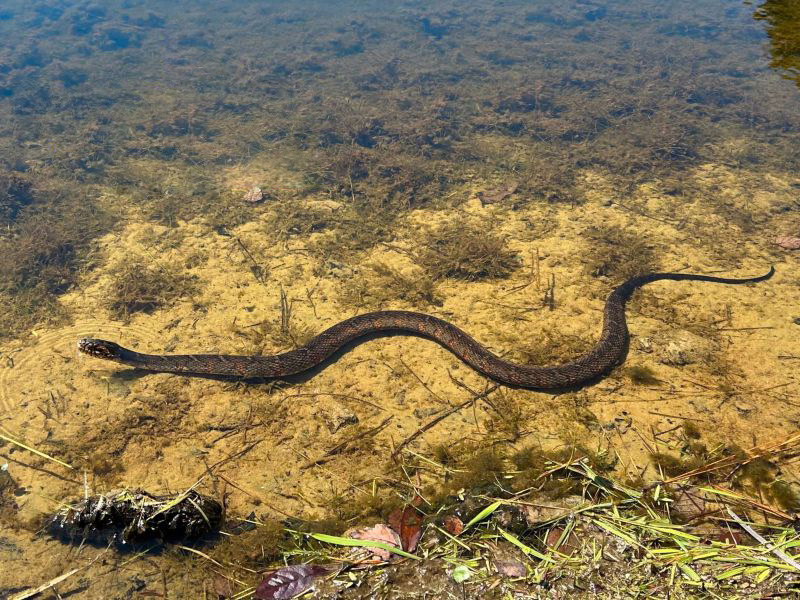
Water snakes (pictured) are often a harmless creature to stumble upon, but they can be easily mistaken for two venomous snakes: The cottonmouth (or water moccasin) and the copperhead. Knowing the key differences can help you appreciate these creatures from a safe distance!
Here’s how to tell them apart:
- Head Shape: Water snakes have a more rounded, slender head that blends into their neck. Venomous cottonmouths and copperheads have a distinct, triangular-shaped head
- Pupils: A water snake has round pupils, while both cottonmouths and copperheads have vertical, slit-like pupils, similar to a cat’s eye.
- Pattern: Copperheads have a distinct “hourglass” pattern that is narrow along the back and wide on the sides. The bands on a water snake are typically the opposite, being wider on the back and narrower on the sides.
- Behavior in Water: A cottonmouth will often swim with its entire body floating on the surface of the water, while a water snake swims with its body mostly submerged.
Try to always to observe from a distance. It’s best to never attempt to handle a snake. Respecting their space keeps you and the wildlife safe!
Having issues with snakes? Let our team at Foster Lake & Pond Management evaluate and advise.