

Welcome to the second installation in Bland Landscaping Company’s pruning series! Tyner Tew kicked off the topic with a great introduction to pruning crape myrtles, and tips on how to recognize and deal with bark scale. In our latest video, we’ll cover more pruning tips.
Crape myrtles are one of the most beautiful and iconic flowering trees in the South—but they’re also one of the most commonly over-pruned plants in the landscape. Ready to learn the right way (and time) to prune crape myrtles to promote healthy structure, strong growth, and vibrant blooms?
Watch to find out:
- The best time of year to prune crape myrtles
- Why topping or “Crape Murder” causes long-term damage
- How proper selective pruning enhances the tree’s natural form
Whether you manage a large community, commercial site, or your own home landscape, these tips will help keep your crape myrtles healthy, attractive, and blooming beautifully year after year.
Watch the video on YouTube, or check out the transcript below.
Read the Transcript
Hey everybody, my name is Jason Smith. I’m with Bland Landscaping, and today we’re going to talk about crape myrtle pruning and crape myrtles in the landscape.
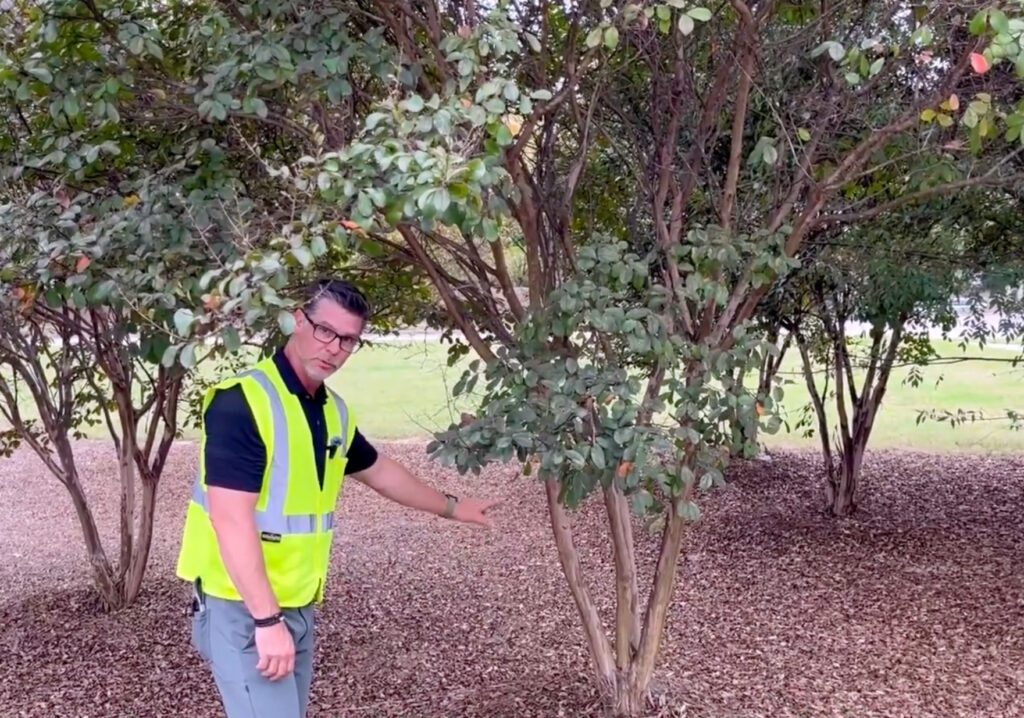
Next to me, we have a multi stem crape myrtle. It’s probably 12 to 15 feet tall, and this is pretty typical of what we’d see in an HOA setting or commercial setting. This does need a little bit of pruning, and we want to talk about timing of pruning, what we do for pruning, and what we don’t do for pruning. So first we would look at canopy height.
In a setting like this, especially around some turf or something, I’d want a little bit more canopy height—and the same if it was near a sidewalk or the front of a building. So, this one does have a lower canopy. Some of these lower limbs we would probably want to take off.
There’s a few dead ones in here that I can see that I would remove. When the wind blows or it rains, they’ll cross and it will rub off the bark—and create basically an open wound on it. It can cause issues with disease or rot. So, we’ll want to remove one of those to relieve that.
Our responsibilities for pruning is what we call pedestrian clearance, meaning I want to be able to walk under it if the tree is large enough for that. Clearance, or the bottom, is typically about a third of the total height of the tree. So if this tree was shorter, I may not want to prune it up this high unless it’s over a sidewalk or something. A little bit of canopy height will only go up to eight feet, roughly. Basically, I can reach it from the ground with a pair of hand pruners or a set of loppers would be the canopy height. Once we have that, cleaning out the small branches and any sucker growth that may be at the bottom would get cleaned off. That would be covered within our scope.
Some of the general things we’ve talked about can happen at really any time, but we do make a larger push in the off season. In January and February, we may go in and do a little bit more cleaning up of the interior or any crossing branches. But in this example, if we had just started the property over time, we would work on things like this—especially if they’re along a sidewalk or something like that. In a natural setting like this, one that we’re not walking by all the time, it may be left in this state.
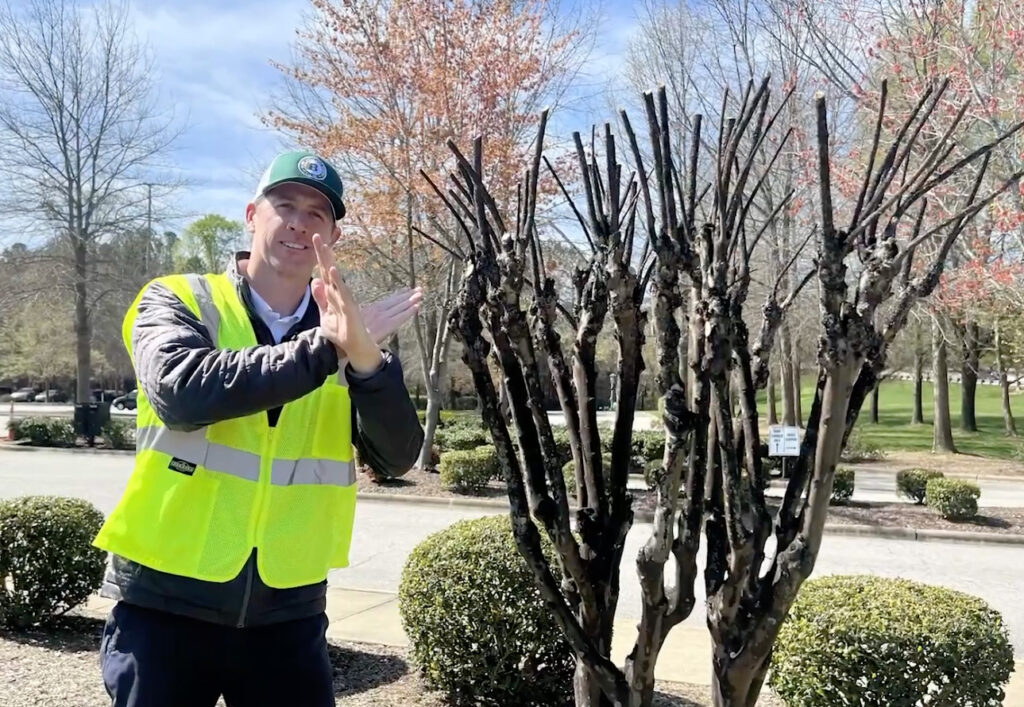
The thing we do not do is top or prune down crepe myrtles. The size doesn’t matter. If this was an eight foot tree, I still wouldn’t top it. I would work on the canopy height and any crossing branches or dead limbs in it.
The common myth with crepe myrtles is topping them down will create more blooms, which isn’t the case. This will get a substantial amount of blooms without topping it down. And you also get a much better tree structure when we don’t prune them down. When we prune them down to the same spot over and over again, you end up with a knot and a broomstick effect of many, many stems coming out of one location. Whereas you can look here, we have many, many stems, but I have many, many supporting branches from the bottom to hold it up. And you end up with a nice cleaner canopy. And in the winter, when this is pruned correctly and the leaves have dropped, you have a nice structure to look at instead of that, you know, popsicle stick with a broom on top that is not very good to look at in the winter.
To wrap up on crepe myrtle pruning, this is a very similar crepe myrtle to the one we were looking at. And we’ve come in and cleaned out the lower branches and have gotten good pedestrian clearance where I can walk underneath it. We’ve cleaned out the little bit of dead that we could see. We didn’t have any crossing branches below, but we have thinned it out and we have a nice canopy. And now it looks like a nice mature tree with a good structure.